

Social Security, explained

Social Security looks simple until you have to decide when to start it. Claim early and you get more checks. Wait and each future check is larger. For couples, the decision also shapes what one spouse might receive after the other dies. Here is the part that matters for retirement planning.
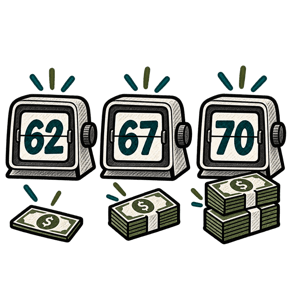
Start with 62, full retirement age, and 70
Social Security retirement benefits start as early as 62. Starting before permanently reduces the monthly benefit. Waiting past full retirement age increases it until 70. After 70, waiting longer does not increase it further. For anyone born in 1960 or later, full retirement age is 67.
So what does waiting buy? A larger monthly check for life. What does claiming early buy? Income sooner. The right comparison isn't only the check amount — it's how those checks fit with the rest of your retirement income and spending.
Break-even age is useful, but it isn't the whole decision
A break-even calculation asks when the larger checks from waiting finally make up for the checks you skipped. That matters. So do how long you live, whether you need income sooner, what your portfolio has to fund while you wait, whether you're married, the potential survivor benefit, taxes, and whether you keep working. A claiming-age calculator that ignores the rest of your retirement plan answers only part of the question. See your own comparison →
Your last salary doesn't set your benefit
SSA generally bases your retirement benefit on your highest 35 years of wage-indexed earnings. Fewer than 35 years of earnings, and zero-earnings years enter the calculation. Continued higher earnings can also replace lower years already in that history. That makes your earnings record worth checking before you plan around an estimate. Check your Social Security earnings record →
Retiring and claiming are two different dates
Stopping work does not require starting Social Security. Someone might retire at 60 and claim at 67. Someone else might work until 68 and wait until 70 to claim. SSA treats the age you stop working and the age you start benefits as separate decisions — though stopping early can matter if it leaves you with fewer than 35 earnings years, or prevents a higher later year from replacing a lower one already on the books.
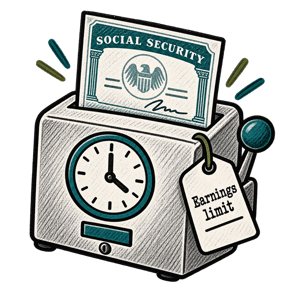
Working while collecting Social Security
Working and receiving Social Security at the same time is allowed. Before full retirement age, earnings above an annual limit temporarily reduce your check — the . For 2026: stay under full retirement age all year and the limit is $24,480, with $1 withheld for every $2 earned above it. In the year you reach full retirement age, the limit is $65,160 for earnings before that month, withholding $1 for every $3 above it. Starting the month you reach full retirement age, the earnings test ends, and SSA recalculates your benefit to credit the months that were withheld.
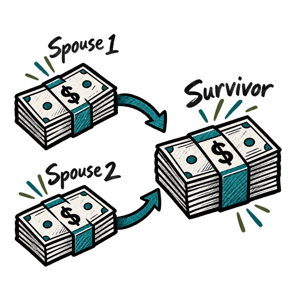
Couples have two decisions, not one
A couple doesn't need to choose the same claiming age. One spouse might claim earlier for cash flow while the other waits. This matters most when one spouse earns much more, because after one spouse dies, the household no longer receives both full checks. A surviving spouse generally receives the higher of the two benefits, ranging from about 71.5% to 100% of the deceased spouse's benefit depending on when the survivor claims — and delayed retirement credits the deceased worker earned carry into that survivor number. See for how filing single afterward changes the tax picture too. That makes the higher earner's claiming decision a household decision, not only an individual one.
Spousal benefits
A spouse with a smaller retirement benefit may qualify for an additional amount based on the other spouse's work record. At the spouse's own full retirement age, the maximum spousal benefit is up to 50% of the worker's full-retirement-age benefit — not 50% of a larger benefit the worker built by waiting until 70. If someone qualifies for both their own benefit and a spousal benefit, SSA pays an amount equal to the higher eligible one, not both added together.
Divorced? Your ex-spouse's record might still matter
Someone divorced after a marriage lasting at least 10 years may qualify for a benefit based on the former spouse's record, generally if they are unmarried, at least 62, and their own benefit is smaller. After two years divorced, this can apply even if the former spouse hasn't started collecting yet, as long as the former spouse is old enough and otherwise eligible. Claiming on an ex-spouse's record does not reduce the ex-spouse's own benefit. Surviving divorced spouses follow a different set of rules, including their own remarriage provisions.

Social Security gets taxed too
Social Security isn't automatically tax-free. Federal rules look at your — roughly half your benefit plus your other income — and depending on the result, up to 85% of your benefit can become taxable. That doesn't mean an 85% tax rate; it means up to 85% of the benefit is included in taxable income and taxed under your normal rate. IRA withdrawals, pensions, RMDs, investment income, capital gains, and Roth conversions can all push more of it into tax, which is why Social Security and Roth planning belong together. See the full tax picture → · Roth conversions, explained →
Social Security gets inflation adjustments
Social Security uses an annual , or COLA. Both early and delayed benefits receive future COLAs — waiting first establishes a larger base benefit, then future raises apply to that larger amount.
Waiting for Social Security doesn't mean waiting for Medicare
Social Security and Medicare run on different clocks. Someone waiting until 70 for Social Security still generally needs to handle Medicare enrollment around 65, unless an exception applies. Missing the right enrollment window can mean delayed coverage or higher costs. Medicare and Medicaid, explained →
Child and dependent benefits are official-eligibility questions
A worker's retirement benefit can sometimes create a benefit for a child or other dependent. That depends on SSA eligibility rules and the family facts.
RetireRebel treats this as education and official-resource routing. It does not estimate a child's monthly benefit or decide whether a dependent qualifies.
Use your my Social Security account or SSA directly for the official amount, then add any confirmed income to your roadmap.
Turning 70 means the delay credits are done
Waiting past age 70 does not raise a Social Security retirement benefit. If you are turning 70 and have not filed, make the filing task visible.
RetireRebel can put the filing review on your Timeline and show how the claim age fits your roadmap. It does not file automatically or guarantee that age 70 is best for every household.
Apply through SSA or confirm your official filing window before relying on the income in a plan.
Have a government pension? Old advice might be out of date
For years, the Windfall Elimination Provision and Government Pension Offset reduced Social Security for many people with pensions from jobs that didn't pay into Social Security. The Social Security Fairness Act repealed both, signed January 5, 2025, applying to benefits payable for months after December 2023. If an older estimate you were given included WEP or GPO, check your current SSA record rather than relying on the old figure.
The 2026 numbers worth knowing
- Cost-of-living adjustment: 2.8%
- Earnings limit under full retirement age all year: $24,480, withheld $1 per $2 over
- Earnings limit in the year you reach full retirement age: $65,160 (before that month), withheld $1 per $3 over
- After full retirement age: no earnings test at all
Social Security Administration, 2026 COLA fact sheet. These figures change every year — confirm the current ones at SSA before relying on them.
Before you file
Check the earnings record SSA has for you. Compare more than one claiming age. For couples, look at the survivor result, not only today's household income. Include taxes and portfolio withdrawals in the comparison. Handle Medicare separately if you plan to delay past 65. If spousal, divorced-spouse, or survivor rules might apply, verify the official benefit directly with SSA. Open your my Social Security account →
Educational only. RetireRebel is an educational tool, not the Social Security Administration and not a financial advisor. Confirm your official earnings record, eligibility, and benefit amount with SSA before filing.