

Medicare, Medicaid, and long-term care
They sound alike. They solve different problems. Medicare is federal health insurance, mostly for people 65 and older. Medicaid is a federal-state program for people who meet financial and other eligibility rules. One distinction matters enormously in retirement: Medicare does not pay for ongoing custodial care in a nursing home. Medicaid might. That difference can move hundreds of thousands of dollars through a retirement plan.
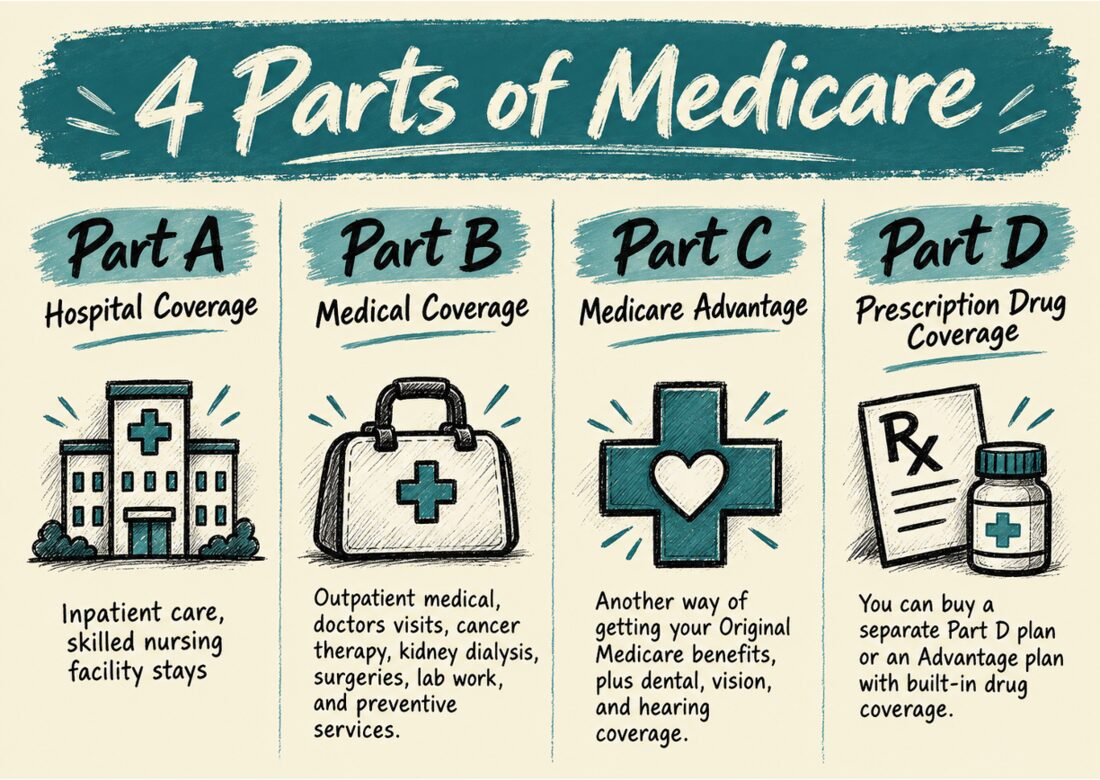
Medicare has four parts
Most people become eligible at 65, though some qualify earlier for disability, ALS, or End-Stage Renal Disease. Part A covers hospital care. Part B covers doctors and outpatient care. Part C, Medicare Advantage, is a private-plan alternative for receiving your Part A and B benefits, usually with Part D bundled in. Part D covers prescription drugs. Medigap, below, is supplemental insurance for Original Medicare — it is not another Medicare part.
Part A: hospital insurance
Think inpatient: hospital stays, limited skilled nursing after a qualifying hospital stay, hospice, and certain home health. Most people pay no monthly premium, since they or a spouse paid Medicare taxes for at least 10 years. In 2026, the inpatient hospital deductible is $1,736 per benefit period, then $0/day for days 1–60, $434/day for days 61–90, and $868/day for lifetime reserve days 91–150. A benefit period isn't a calendar year — more than one deductible can apply in a single year.
Part B: doctors and outpatient care
Doctor visits, outpatient care, preventive services, lab work, durable medical equipment, and therapy. The standard 2026 premium is $202.90/month with a $283 annual deductible, then generally 20% coinsurance on covered services. Original Medicare has no annual out-of-pocket maximum for Part A and B, which is why most people pair it with Medigap, Medicaid, retiree coverage, or another supplement. Your premium can also run well above the standard amount — that's , covered below.
Part C: Medicare Advantage
Not an add-on to Original Medicare — an alternative way to receive your Part A and B benefits through a private insurer, usually with Part D and extras like dental or vision bundled in. You still pay your Part B premium, plus whatever the plan itself charges (sometimes $0). A $0 Advantage premium is not $0 health care: compare the normal year premium and copays against a bad-health year with hospital, specialist, drug, network, referral, and prior-authorization friction. Unlike Original Medicare, these plans cap your annual out-of-pocket cost, but usually trade that for network rules, referrals, or prior authorization. Neither choice is automatically better — it depends on premiums, expected use, your doctors, and how much network friction you can tolerate.
Part D: prescription drugs
Private insurers set their own premiums and drug lists, so your medications determine which plan actually saves you money. For 2026, a Part D plan can't charge a deductible above $615, and once your covered out-of-pocket drug spending hits $2,100, you pay nothing more for covered drugs the rest of the year. Old donut hole advice can be misleading now; use current Part D plan costs, pharmacy networks, and your own prescriptions instead. Higher earners also pay a Part D IRMAA surcharge on top of the plan's own premium.
: what fills Original Medicare's holes
Medigap is private supplemental insurance that helps pay your share of Medicare-covered deductibles, copays, and coinsurance — standardized in most states by letter, like Plan G or Plan N. It is not long-term-care insurance: it generally excludes nursing-home custodial care, most dental and vision, hearing aids, and private-duty nursing. Your one-time six-month Medigap Open Enrollment Period begins the first month you're both 65 or older and enrolled in Part B — so if you delay Part B on employer coverage, it waits until Part B starts. Insurers generally can't deny you for health reasons during it. Outside that window, Medigap rights vary by state, health history, timing, and situation; trial rights are situational, and leaving Advantage does not guarantee Medigap.
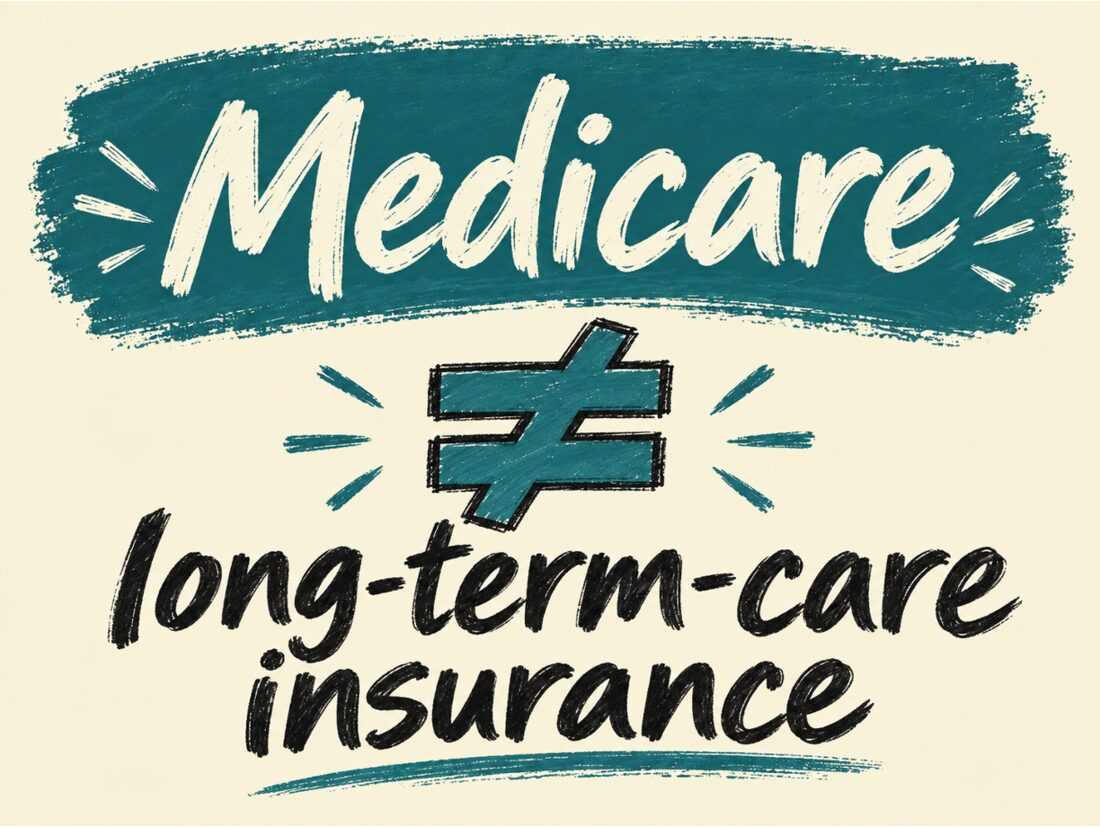
The Big Medicare Myth: nursing homes
Medicare does not pay for ongoing custodial nursing-home care — one of the most important facts in retirement planning. Custodial care is help with daily activities: bathing, dressing, eating, using the bathroom, moving around safely. Medicare generally doesn't cover it, whether it happens in a nursing home, assisted living, or at home.
The confusion comes from Medicare Part A sometimes paying for a skilled nursing stay — short-term recovery care after a qualifying hospitalization, not permanent nursing-home coverage. For 2026, skilled nursing facility care under Original Medicare is capped at 100 days per benefit period:
Someone might spend weeks in a facility after a stroke or surgery with Medicare covering part of it. That does not mean Medicare pays once the need becomes years of help with daily living — see .
So who actually pays for long-term care?
Some combination of your own money, long-term-care insurance, Medicaid if you qualify, VA programs for eligible veterans, and other state or community programs. Medicaid is the largest public payer of long-term services in the country, covering both nursing facilities and home- and community-based programs for eligible people. Model long-term care in your roadmap →
Medicaid: a different program, a different test
Medicaid is jointly funded by federal and state governments, and eligibility and benefits differ by state. It matters for retirement in two ways: it can help lower-income Medicare beneficiaries pay premiums and cost-sharing, and it is the major payer for long-term care, including nursing facilities and, in many states, care at home.
How you qualify for long-term-care Medicaid
There's no single nationwide number — states run Medicaid within federal rules, and eligibility varies by state and category. For long-term care, it generally comes down to two separate tests: a financial test on income and countable resources, and a care-needs test on whether you meet the state's required level of care. Rules differ for married couples, since federal law protects a share of assets and income for the spouse who stays in the community. Don't assume you're ineligible just because you didn't qualify for ordinary Medicaid before — nursing-home eligibility pathways can differ, and some states use higher income limits for nursing-home residents.
Medicaid can pay for nursing-home care
A common path: someone enters a facility after a hospitalization, Medicare pays for a qualifying short-term skilled stay, the person still needs custodial care once that ends, they pay privately or through insurance, and if they later meet Medicaid's requirements — at a facility that accepts Medicaid — Medicaid takes over qualifying nursing-facility costs. Not every facility participates, so that matters when choosing one.
Medicaid might also help you stay home
Medicaid long-term care isn't limited to institutions. States run Home and Community-Based Services (HCBS) programs that help eligible people get care at home instead of moving into a facility — personal care, respite care, case management, home modifications, transportation, and more, depending on the state. Some states also let participants self-direct their care, including hiring and paying a family member; see . Programs and availability vary widely by state, but for many people this becomes part of the financial path to aging at home.
Medicare and Medicaid at the same time
Yes — people enrolled in both are called dual eligible. Medicare generally pays first for Medicare-covered services; Medicaid can then help with premiums and cost-sharing and cover what Medicare doesn't, including qualifying long-term care. Programs can help pay Medicare costs without this guide deciding eligibility: Medicare Savings Programs can help with premiums and cost-sharing, while Extra Help is prescription-drug help for Part D costs. Check the current program rules even if you assume your income is too high.
Medicaid's five-year lookback
When you apply for long-term-care Medicaid, states review asset transfers over the prior 60 months. Giving money or property away for less than fair market value in that window can trigger a penalty period during which Medicaid won't pay for care — exceptions exist, including some spousal transfers. “Give everything to the kids before the nursing home” is not a retirement plan. Large transfers deserve qualified elder-law guidance before you act, not after.
Medicaid estate recovery
For Medicaid beneficiaries 55 and older, states generally must try to recover certain payments — nursing-facility care, home- and community-based services, and related costs — from the person's estate afterward. Federal law includes protections, including when a surviving spouse or certain children remain, and states run hardship-waiver processes. Medicaid paying for care doesn't always mean the cost disappears for good; it belongs in the same legacy conversation as everything else.
PACE: another option worth knowing
PACE can coordinate care in some areas. The Program of All-Inclusive Care for the Elderly combines Medicare and, for eligible people, Medicaid into one coordinated program meant to keep frail older adults in the community — medical care, adult day care, home care, transportation, prescriptions, therapy, and nursing-home care when it's needed. Generally you must be at least 55, live in a PACE service area, meet the state's nursing-home level-of-care standard, and be able to live safely in the community at enrollment. It isn't available everywhere, and this guide is not an eligibility decision.
Higher earners pay more than the standard Part B premium — the , added to Part B and D. It uses your MAGI from two tax years earlier, so a decision at 63 can raise your Medicare bill at 65.
CMS fact sheet: 2026 Medicare Parts A & B Premiums and Deductibles, confirmed 2026-09 · 2-year MAGI lookback
The IRMAA trap
IRMAA runs off MAGI, not just wages — a large IRA withdrawal, an RMD, a , capital gains, a taxable home-sale gain, pension income, or a business sale can all push you into a higher tier. A home sale can temporarily raise IRMAA when the taxable gain lands in the lookback year; it does not automatically create an appeal right. A conversion at 63 can raise your Medicare premium at 65, which is why Roth and Medicare math have to live in the same model. Roth conversions, explained → · The full tax picture →
You might be able to appeal IRMAA after retiring
The two-year lookback creates an obvious problem: earn a large salary at 63, retire at 64, start Medicare at 65, and Medicare initially prices you off the old high-income return. Social Security lets you request a lower IRMAA after certain life-changing events that cut your income — work stoppage or reduction, marriage, divorce, a spouse's death, loss of income-producing property, some pension changes. The form is . A voluntary Roth conversion does not qualify just because it raised your IRMAA.
Medicare doesn't cover everything
Even with Parts A and B, Original Medicare generally excludes long-term custodial care, most routine dental, routine eye exams for glasses, most hearing aids, routine physical exams, and most care outside the US. Some Medicare Advantage plans add extra dental, vision, or hearing; Medigap may cover certain foreign-travel emergencies. Neither is long-term-care insurance.
When do you sign up?
Coverage generally starts around 65; some people are enrolled automatically, others have to sign up. Medicare enrollment windows depend on the current date, your current coverage, and the move you want to make. COBRA usually is not active-employer coverage for Part B timing, so confirm before treating it like a special-enrollment shield. Delay Part B without qualifying employer coverage or another special enrollment period, and the late-enrollment penalty generally raises your premium 10% for every full 12 months you waited — often for as long as you have Part B. Part D has its own late-enrollment penalty for going too long without creditable drug coverage. Waiting until 70 for Social Security does not mean waiting until 70 for Medicare — they're separate decisions. Social Security, explained →
What this means for your retirement plan
Medicare is not free health care. A plan needs room for Part B and D premiums, IRMAA when it applies, Medigap or Medicare Advantage premiums, deductibles, copays and coinsurance, dental/vision/hearing costs, prescriptions, and a separate plan for long-term care. Medicaid isn't automatic nursing-home insurance either — eligibility, assets, income, the five-year lookback, state rules, the spouse who stays home, and estate recovery all matter. RetireRebel models these as part of the full retirement picture rather than assuming Medicare covers the bill after 65.
Where to get real answers
- medicare.gov — what Medicare does and does not cover.
- medicaid.gov — Medicaid long-term-care rules and how they vary by state.
- ssa.gov/medicare — IRMAA and appeals, including SSA-44.
- shiphelp.org — free, unbiased Medicare counseling through your State Health Insurance Assistance Program.
- eldercare.acl.gov — the Eldercare Locator, for local help and your Area Agency on Aging.
Educational only. RetireRebel is a planning tool, not Medicare, Medicaid, Social Security, a health insurer, or a legal or financial advisor. Medicare and Medicaid rules, costs, eligibility limits, and available programs change, and Medicaid rules differ by state. Confirm coverage and eligibility with the applicable government program before acting.