

Taxes in retirement

The paycheck stops. The tax bill doesn't. Retirement taxes are less about one rate and more about what piles on top of what: an IRA withdrawal can make more of your Social Security taxable, a Roth conversion can push gains into a higher bracket, and either can raise your Medicare premiums two years later.
What still counts as income
Working years usually have one dominant source of taxable income: your paycheck. Retirement can have six at once: traditional IRA and 401(k) withdrawals, , , pension income, part of your Social Security, interest and dividends, capital gains, rental income, and part-time or consulting pay. Qualified Roth withdrawals are the exception — they generally stay out of taxable income entirely, which is why a Roth balance is useful for controlling income later.
Social Security gets taxed too
The IRS taxes Social Security based on your — roughly half your benefit plus your other income. Cross certain levels and up to 85% of your benefit becomes taxable. The trap: take an extra $20,000 from an IRA and the real hit to your taxable income can be bigger than $20,000, because the withdrawal also drags more of your Social Security into tax. See the full Social Security picture →
Required minimum distributions
Eventually the IRS starts choosing part of your withdrawal schedule for you. An forces money out of most pre-tax accounts starting at 73 or 75, depending on your birth year, whether or not you need the cash. That extra income can push you into a higher bracket, tax more of your Social Security, trigger NIIT, and raise Medicare premiums two years later. Miss one and the shortfall owes a 25% excise tax, down to 10% if corrected within the IRS window — which is one reason the years between retiring and RMDs starting are worth using for Roth conversions.
State taxes are the other half
States write their own rules on Social Security, IRA and 401(k) withdrawals, pensions, and capital gains — some tax all of it, some none. A lower-income-tax state can still come with higher property tax, insurance, or sales tax, so the question isn't “which state has the lowest income tax,” it's what living there does to your whole plan. And you don't change your by declaring a favorite state — states look at where you actually live, your days there, your license, and your filings.
Capital gains
You're taxed on the gain, not the sale price. Long-term get federal rates of 0%, 15%, or 20% depending on your taxable income — a lower-income year can put some gains in the 0% bracket. But income stacks: a conversion, RMD, or pension can use up that room and push the same gains into a higher rate, or trigger NIIT below.

Selling your home
The math is sale price, minus selling costs, minus your adjusted basis (what you paid, plus qualifying capital improvements) — that's the gain. If it's your main home, federal law lets you exclude up to . Only the amount above that is taxed, but a large gain can also raise NIIT exposure, Medicare premiums two years out, and ACA credits before 65 — timing a sale around other income matters.
Applies once your MAGI passes $200,000 single or $250,000 married filing jointly — statutory thresholds that are never inflation-indexed. A isn't investment income itself, but it raises MAGI, which can expose gains, interest, and dividends you already had to the surtax.
IRC §1411 (not inflation-indexed), confirmed 2026-01

Early withdrawals before 59½
Retiring before 59½ adds a reach problem on top of a tax problem: most early distributions face ordinary tax plus a 10% , unless an exception applies (the Rule of 55 for the plan at the job you just left, or a 72(t)/SEPP schedule). What works for a 401(k) doesn't automatically work for an IRA — account type and sequence matter as much as portfolio size.
adds a surcharge to Medicare Part B and D once your MAGI from two years earlier crosses a tier. A decision at 63 can raise premiums at 65.
If your income dropped because you retired, you can appeal with — a voluntary Roth conversion doesn't qualify as a life-changing event.
CMS fact sheet: 2026 Medicare Parts A & B Premiums and Deductibles, confirmed 2026-09 · 2-year MAGI lookback
ACA premium tax credits before 65
Retire before Medicare and income starts affecting health premiums too. The temporary expanded eligibility has expired for 2026 — cross 400% of the federal poverty level and the credit disappears entirely, not just shrinks. A conversion that saves tax later can cost more in premiums today; that trade belongs in the same calculation.
Property, sales, and the rest of the state bill
Income tax gets the attention, but retirement spending happens after property tax, sales tax, and — in some places — personal property tax on vehicles and boats. “No state income tax” doesn't mean “low-tax retirement”; it belongs in the same relocation math as everything else.
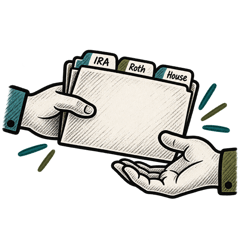
What happens when money goes to your heirs
Most non-spouse heirs who inherit a traditional IRA must empty it within 10 years, and every withdrawal is taxable to them (see ). Leaving a large pre-tax IRA to kids in their peak-earning years can cost more in tax than the balance suggests — converting during your own lower-income retirement years can shift that bill from their return to yours.
Federal exclusion: $15,000,000 per individual. Annual gift-tax exclusion: $19,000 per recipient, per donor — gifts above that reduce your lifetime exclusion rather than triggering tax immediately. Far fewer households owe federal estate tax than assume they will; some states set their own, much lower thresholds.
OBBBA 2025, confirmed 2026-01
Ways to lower taxable income
A few rules work in your favor. A sent straight from an IRA to charity after 70½ counts toward your RMD without ever showing up as income. The below adds real room for 65+ households through 2028. Qualified Roth withdrawals never add to taxable income. And realized losses can offset gains, with a limited amount offsetting other income each year.
Up to $6,000 per person 65 and older, on top of the standard deduction. Phases out at 6% of MAGI above $75,000 single or $150,000 married, applied to each person's amount, so it is gone at $175,000 single or $250,000 joint. These amounts are fixed by law, not indexed. Sunsets after 2028.
26 U.S.C. §151(d)(5)(C) (One Big Beautiful Bill Act §70103); IRS Schedule 1-A, confirmed 2026-09
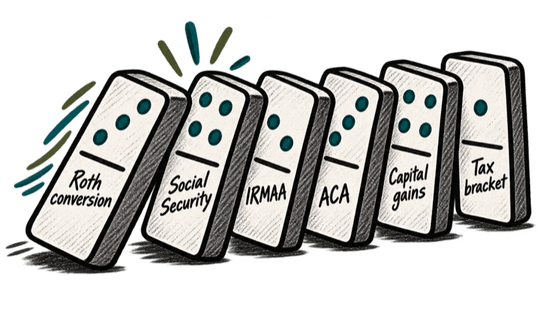
The tax dominoes
One decision rarely changes one bill. A Roth conversion can drag more Social Security into tax, restack capital gains into a higher rate, trigger NIIT, shrink the senior deduction, and raise Medicare premiums two years later — all from the same dollar of income. A large RMD, a big investment sale, or a home sale can each set off the same chain. The useful question is rarely “what's my tax bracket?” It's “what happens to everything else if I create another dollar of income this year?”
Educational only. RetireRebel is an educational tool, not a tax advisor. Tax rules change, and individual returns include details a projection will not know. Confirm decisions you plan to act on with a qualified tax professional.