
Roth conversions, explained
One of the biggest levers in retirement, and one of the murkiest. Here is what a conversion is, how the ladder works, the backdoor versions, and the part most articles skip: when not to do it.
What a Roth conversion is
A moves money from a pre-tax account (a traditional 401k or IRA) into a Roth. You pay ordinary income tax on the amount you move now, and in exchange it grows tax-free, comes out tax-free, and has no required withdrawals later. You are choosing to pay tax at today's rate instead of a future one.
The conversion ladder
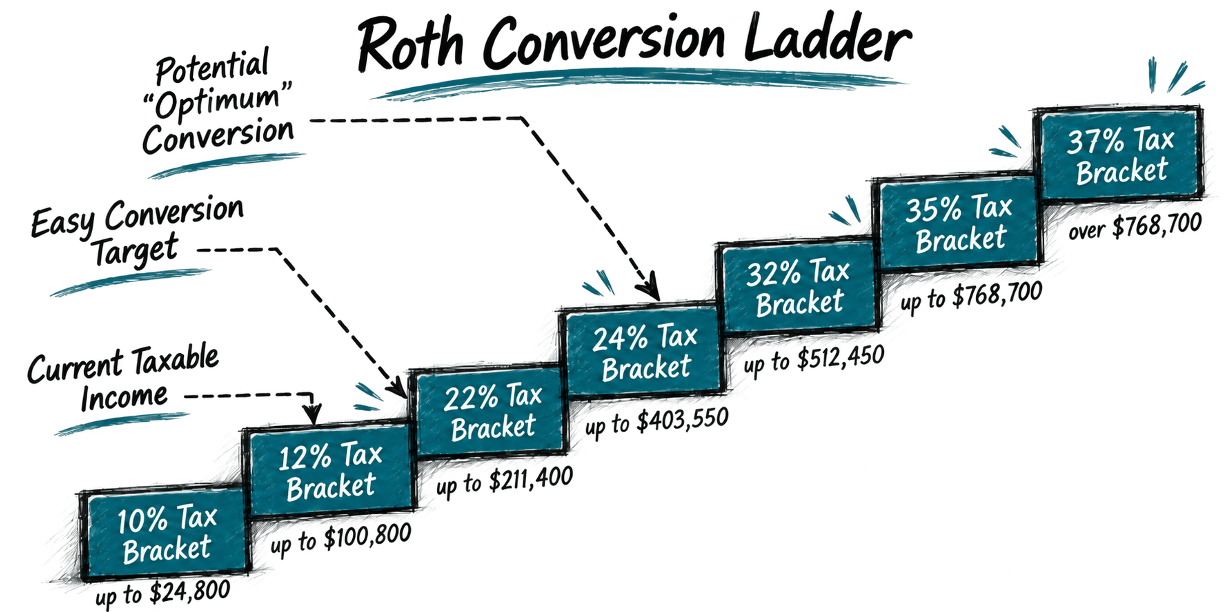
The window that makes conversions worth it is usually the low-income years between when you stop working and when Social Security and begin. In those years your bracket is low, so you convert a chunk each year, just enough to “fill” a target tax bracket without spilling into the next one. Do that for several years running and you have a ladder: a steady, deliberate shift of money from the taxed column to the tax-free one, at the cheapest rate you will ever see.
Backdoor and mega backdoor Roth
If you earn too much to contribute to a Roth directly, two side doors exist. The puts money in a traditional IRA and immediately converts it. The uses after-tax contributions inside a 401k that allows them, moving much larger amounts to Roth. Both have traps, especially the pro-rata rule, which can make a backdoor conversion partly taxable if you hold other pre-tax IRA money.
When not to convert
A conversion is not free money, and for plenty of people it is the wrong move. Reasons to slow down or skip it:
- Your bracket won't be lower later. If today's rate is as low as it will get, converting just prepays a tax you could have spread out.
- You would pay the tax from the account itself. Converting works best when you pay the tax from taxable savings. Paying it out of the converted money undercuts the whole point.
- A short horizon. Tax-free growth needs years to pay off. Later in life, or with health concerns, there may not be enough runway.
- It tips a hidden threshold. A big conversion can raise Medicare surcharges two years later, make more of your Social Security taxable, push long-term gains into a higher bracket, trigger the , or blow past the cliff before 65. The tax on the conversion is only part of the bill.
- Your heirs are in low brackets. If the people inheriting the money will pay little tax on it, converting for their benefit can be a wash or worse.
- You are about to move to a lower-tax state. Convert after the move, not before, so a high-tax state doesn't take a cut on the way out.
The honest answer is that it depends on your whole picture: your brackets now and later, your other income, Medicare, and how long the money has to grow. That is exactly the tradeoff RetireRebel models year by year, surcharges and all.